M5Stack Core2 ESP32 IoT kit
With LTE and LoRa modules for remote connectivity, so a device can report from places without Wi-Fi.
Product page →Technical approaches to detect and measure sonic booms, and the portable device we are building to do it around the clock.
A sonic boom is not like ordinary noise. Its energy sits in the 0.1–100 hertz range, so standard audio equipment and smartphones cannot accurately record, measure or play it back. Detecting booms reliably means purpose-built sensors that can capture very low frequencies, together with software that can tell a genuine boom apart from a passing truck or a slammed door.
We are working to create a portable, easy-to-use device that will help detect sonic booms. Prototype devices are currently housed in Pelican Micro Cases, and we are looking at small solar arrays with lithium battery storage so that each unit can run unattended. Our goal is 24x7 device operation.
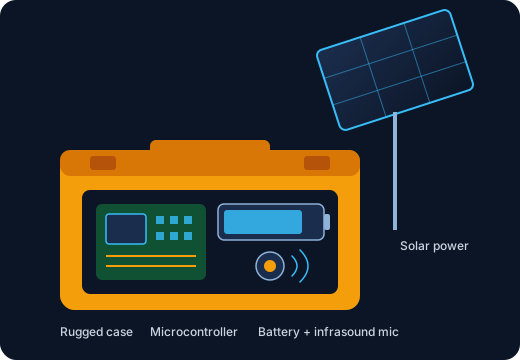
With LTE and LoRa modules for remote connectivity, so a device can report from places without Wi-Fi.
Product page →A low-power microcontroller with compatible sensor and radio modules.
Product page →Software to process, visualise and analyse the data the devices collect. Any programming language is okay for now.
Help build it →The device, the firmware and the analysis software are all being built by volunteers. Your skills could move the project forward.